
Debut Novel · Literary Fiction · Complete at 409 pages
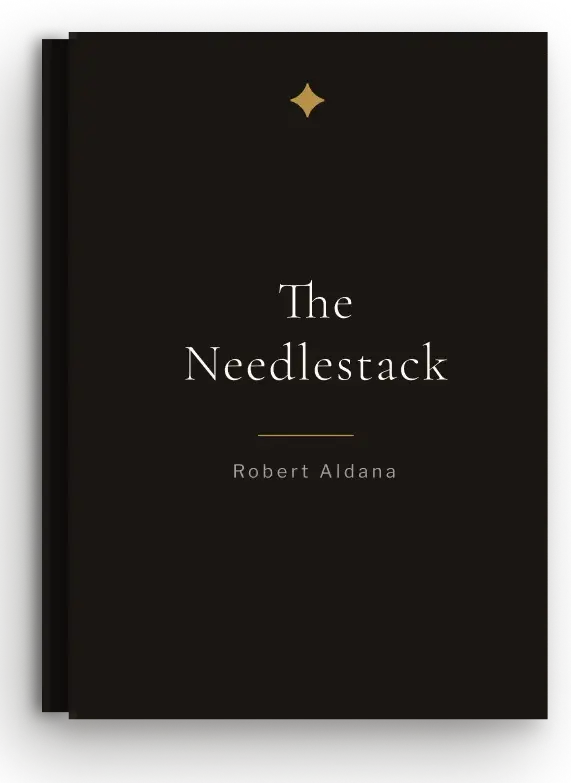
A Novel by Robert Aldana
A young Cuban-American writer trades Wall Street for a Spanish village school — and discovers that the truest education is one that cannot be planned, controlled, or undone.
“Life isn’t about avoiding problems. It’s about finding the right ones to solve.”
— Ray, The Needlestack — and Aldana’s hardest-won truth
What the Critics Would Say
Robert Aldana has written the kind of first novel that makes a reader feel they have been waiting for it without knowing what they were waiting for — a book that inhabits the cramped, overcrowded, and strangely gorgeous world of early adult life in New York with an alertness of observation and a generosity of spirit that places it firmly in the tradition of the great social novels of self-invention.
From its opening pages — a Russian bath in the Financial District, a hangover, a Frenchman waxing poetic about the grime of locker rooms — The Needlestack announces itself as fiction concerned not with plot as a mechanism but with the granular, accumulating weight of days. Henry, the narrator, is twenty-three, Harvard-educated, Cuban-American, and trapped in a back-office job at Bank of America that he simultaneously cannot afford to leave and cannot endure to stay in. His dilemma is not unique. What makes it literature is the quality of his attention.
Aldana writes prose with the unhurried authority of a novelist twice his age. His sentences have the suppleness of Chekhov and the comic timing of P.G. Wodehouse — sentences that turn a corner, pause, and reveal something quietly devastating. A description of the office floor — “a sea of gray cubicles undulating as far as the eye could see, a sea dotted with wispy white hair and shiny bald heads rising here and there like little foaming crests” — is not mere observation. It is a man fretting about his future. This is the book’s signature move: comedy in the service of elegy.
The novel’s structural ambition is its most underrated quality. Aldana weaves two parallel narratives — Henry’s reluctant present in New York and an invented medieval dungeon fantasy he writes during office hours — into a single tonal register. The dungeon sections, which begin as escapist comedy, gradually accumulate their own moral weight, becoming a distorted mirror of the spreadsheet Henry is tasked with maintaining: a register of who is essential and who is disposable. It is a masterstroke of structural irony that most debut novelists would never dare attempt.
At its emotional center, The Needlestack is a novel about the education of feeling. Henry’s affair with Magda — a Hungarian playwright, married, older, brilliant, and thoroughly unencumbered by sentimentality — is rendered with a psychological precision that recalls the work of Milan Kundera and Elena Ferrante. Magda is not a muse or a plot device; she is an equal, perhaps a superior, and the novel has the intellectual honesty to acknowledge it. Their pivotal meeting at Cleopatra’s Needle, with its ancient indifference to human vanity, is among the finest scenes of romantic valediction in recent American fiction.
Part Two’s relocation to Fraga — a small agricultural town in Aragon where Henry has been assigned as an English teacher — announces a tonal shift from observational comedy to something closer to moral fable. The town, its inhabitants, and its petty bureaucracies become a crucible. A student’s infatuation. A gym teacher’s abuse of authority. A principal’s complicity. A false accusation. Aldana handles these materials unflinchingly and, crucially, without moralizing. Henry is not a hero. He is a witness who must decide what witnessing obligates.
What finally distinguishes The Needlestack from the many novels of millennial drift that have preceded it is its refusal of the easy satisfactions of that genre: neither the wisdom-earned epiphany nor the ironized failure. The final section — set at François’ family home in Corsica and then at Ray’s restaurant in Brooklyn — offers something rarer: the tentative, provisional, good-enough beginning of a life genuinely chosen. Ray opening his restaurant is not triumphant. It is hopeful, which is a harder and more honest thing.
Robert Aldana is a writer of exceptional formal intelligence and even more exceptional warmth. The Needlestack is the complete, assured, and deeply felt first novel of a major literary talent.
Synopsis
Henry, twenty-three, is a Cuban-American aspiring writer working at Bank of America in lower Manhattan — a job he can’t quit because he spent his signing bonus and can’t quit because the contract won’t let him and, eventually, can’t quit because they keep offering him better terms for doing less work. He writes at his cubicle when his manager is away, maintains an elaborate medieval-dungeon fantasy in the margins of his legal pad, and tries to figure out whether the life he is living has anything to do with the life he intended to live.
Around him orbits a vivid ensemble: Ray, his roommate and line cook, whose emotional unavailability is so philosophical it nearly constitutes a worldview; Francois, the mercurial Frenchman who arrives in New York like a nineteenth-century novel hero and proceeds to live like one; June, the artist whose paintings are the book’s quiet moral center; and Magda, the Hungarian playwright whose marriage is formally troubled and personally irrelevant — a relationship conducted in borrowed time in a borrowed apartment with a doorman as accomplice.
Part Two follows Henry to Fraga, a town of fourteen thousand in rural Aragon, where he goes to teach English and discovers that escape is also a form of arrival. A student develops an infatuation. A gym teacher crosses a line. A false rumor costs Henry his recommendation letter. He learns, finally, that integrity is not heroic — it is private, unglamorous, and almost always inconvenient.
Part Three circles back: a summer in Corsica with Francois, a return to Brooklyn, a warehouse space on Henry Street slowly becoming something called Breakfast at Mine. The novel ends not with resolution but with something better — the first honest gesture toward a life genuinely, freely chosen.
Novel Architecture
Part One
New York
Financial District · Brooklyn · Manhattan. The city as education in ambition, desire, and the price of waiting.
Part Two
Spain
Fraga, Aragon · Madrid · Barcelona. A small town as crucible for identity, belonging, and moral consequence.
Part Three
The Restaurant
Corsica · Brooklyn. The beginning of a life earned, not inherited.

“Language to him was his sixth and his most crucial sense, marshalling the other five with an ecstatic zeal, and for that he was the type of friend around whom one could never utter a lazy word, as he’d either seize upon it with disdain and interrogate it until it was walked back, or, letting it pass in silence, count it as an unbecoming mark against one’s character.”
Page 4 — On Francois, at the banya
Thematic Landscape
01
The novel interrogates what it means to live deliberately — through Henry’s time calculations, his cubicle fantasies, his Spanish studies never begun — against the slow revelation that all time lived honestly is, eventually, used.
02
Henry’s Cuban father, Francois’s aristocratic wound, Ray’s working-class trajectory, and Magda’s Soviet-era childhood all orbit a central question: what do we owe the generations that made our freedom possible?
03
From Ray’s refusal to say “I love you” to Magda’s fire escape and the door Henry closes at the top of a Spanish stairwell — the novel maps the gap between what we want and what we permit ourselves to want.
04
In Fraga, Henry sees things that implicate him. His decision — to write the letter, to keep the promise, to say “fuck it” and leave — is the novel’s fullest moral statement about what a good person actually looks like under pressure.
05
Henry writes at his cubicle. June paints the mornings Ray’s blinds created. Magda stages plays in fellowships that don’t pay. The novel argues, without sentimentality, that this is not a hobby — it is how certain people remain alive.
06
Every character is displaced — Francois from French aristocracy, Magda from Hungary, Henry from the expectation of Harvard. The novel treats expatriation not as adventure but as a kind of necessary wound that precedes a chosen home.
Every day you sit down to work, you are allowed to say to yourself, I am a writer. It doesn’t matter what you write or if it makes you famous or if you simply do it for yourself. To be a writer is to be someone who writes and writes and writes, in spite of it all. That’s it.
Magda, Page 40 — on what it means to be a writer
Comparable Titles
Agent's Note
The Needlestack occupies a specific and underserved market position: the literary coming-of-age novel written by a man in his twenties that is neither confessionally solipsistic nor ironically detached. Like Hemingway, Aldana writes about young people attempting to live seriously. Like Rooney, he is attuned to the way class and desire distort every relationship. Unlike either, he is genuinely funny — not in the service of deflection, but in the service of honesty.
The novel’s multicultural protagonist — Cuban-American, Ivy League, neither fully insider nor outsider — represents both authentic lived experience and a significant underrepresented audience in literary fiction. The Spain setting opens the work to international rights conversations.
Market Positioning

Literary fiction by and for first-generation and bicultural Americans — readers who see themselves in neither the immigrant novel nor the white coming-of-age.
The novel’s examination of purpose, institutional failure, and the cost of deferred artistic ambition speaks directly to post-pandemic millennial readers reconsidering their lives.
Significant narrative time set in Spain and Corsica. European settings and themes of expatriation create natural hooks for rights conversations across multiple territories.
A first novel with structural complexity — the interwoven office/dungeon parallel narrative — that reflects genuine literary ambition. A manuscript that rewards serious editorial attention.
For Representation Inquiries
Robert Aldana is actively seeking literary representation for The Needlestack. The complete manuscript — 409 pages, three parts, ready for submission — is available on request. A synopsis, query letter, and the author’s full publishing CV are available upon request.